Are you a home or business owner in NYC? Hiring a remodeling contractor in New York City isn’t just about design taste or price. It’s about risk management.
Between co-op boards, DOB permits, insurance requirements, and high-rise logistics, NYC renovations are uniquely complex, and choosing the wrong contractor can lead to delays, rejected board packages, failed inspections, or abandoned projects.
This guide from Grace General Construction Corp, a Bronx-based general contracting and construction company, breaks down exactly how NYC homeowners should choose a remodeling contractor before, during, and after a renovation—so you can protect your investment and your sanity.
Why Hiring a Remodeling Contractor in NYC Is Different Than Anywhere Else
In most cities, you hire a contractor and start work. In NYC, you hire a contractor and satisfy a long list of third parties.
Key NYC challenges homeowners face:
- Co-op vs. condo vs. townhouse rules
- Board approvals and alteration agreements
- DOB permits, inspections, and sign-offs
- Noise, elevator protection, and neighbor impact
- Strict insurance and compliance standards
Out-of-town contractors often fail here not because they’re bad builders, but because they don’t understand NYC systems. A contractor who hasn’t navigated NYC buildings before is a liability.
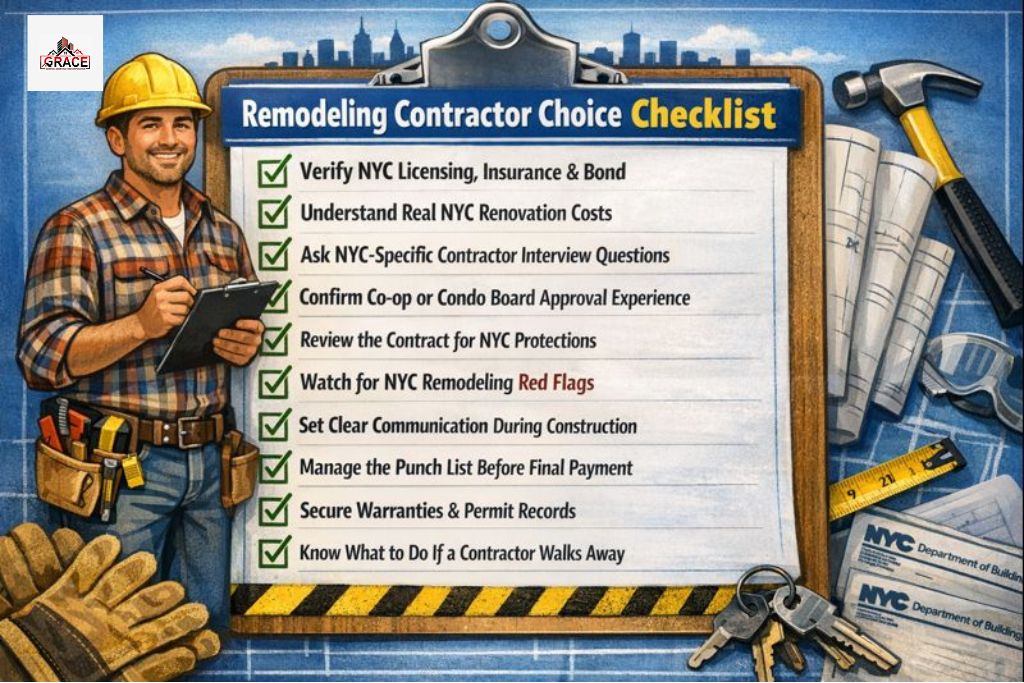
Step 1: Verify Essential NYC Credentials (Non-Negotiable)
NYC Home Improvement Contractor (HIC) License
Every residential renovation contractor must hold an active NYC HIC license issued by the city’s consumer protection authority.
What it does:
- Confirms legal authorization to perform home improvement work
- Allows homeowners to file complaints if disputes arise
What it does NOT do:
- Guarantee quality
- Replace proper insurance
- Protect against under-scoped contracts
Many homeowners assume a license equals safety. It doesn’t. It’s simply the starting line.
Insurance Requirements Explained (COI Breakdown)
NYC buildings will not approve renovations without proper Certificates of Insurance (COIs).
A compliant contractor should carry:
- General Liability Insurance – protects against property damage
- Workers’ Compensation – required if anyone works onsite
- Disability Insurance – NYC-specific requirement many miss
Incomplete COIs are one of the top reasons board packages get rejected—causing weeks or months of delay.
The $20,000 Surety Bond
NYC requires contractors to carry a $20,000 surety bond.
What it protects:
- Homeowners, if a contractor violates consumer protection rules
What it doesn’t:
- Automatically reimburses you without documentation
- Replace legal action in severe cases
Contractors who push cash deals often avoid bonding altogether, a major red flag.
Step 2: Understanding True NYC Renovation Costs Before Getting Bids
Typical Labor vs. Materials Cost Split in NYC Remodels
NYC renovations are labor-heavy.
Typical breakdown:
| Category | Approx. Share |
| Labor & Supervision | 55–65% |
| Materials | 35–45% |
Why does labor cost more in NYC?:
- Union or licensed trades
- Compliance overhead
- Supervision requirements
- Restricted work hours
- Logistics and coordination
If a bid looks “too cheap,” it’s often because labor, supervision, or compliance is being cut.
Why “Get 3 Bids” Often Backfires in NYC
In theory, comparing bids makes sense. In NYC, it often creates confusion.
Common problems:
- Different scopes of work
- Missing permit responsibilities
- Unclear finish allowances
- No supervision details
The lowest bid is usually inefficient, not complete.
Step 3: The Interview: 10 Critical NYC-Specific Questions to Ask
Board & Building Experience
Ask:
- Have you worked in co-ops or condos like mine?
- Who prepares and submits the board package?
- Do you communicate directly with management?
A contractor unfamiliar with boards slows everything down.
Project Execution & Staffing
Clarify:
- Who supervises daily?
- Are licensed subs used for plumbing and electrical?
- How is daily cleanup handled in occupied buildings?
NYC buildings notice everything, and violations add risk.
Contracts & Pricing Transparency
You should understand:
- Fixed price vs. allowance items
- Change order process
- Payment schedule tied to milestones
Large upfront deposits are not normal in NYC.
Step 4: Navigating the Co-op & Condo Board Approval Process
What’s Included in a Complete Board Package
A proper package includes:
- Detailed scope of work
- Architectural drawings (if required)
- Permits or permit strategy
- Contractor licenses, COIs, and bond
- Alteration agreement acknowledgments
Common Reasons Board Packages Get Rejected
- Incomplete insurance certificates
- Vague scopes
- Contractors unfamiliar with building rules
Every rejection adds weeks. Experience matters.
Step 5: Contract Review: What NYC Homeowners Miss
Clauses That Protect You
Look for:
- Payments tied to milestones
- Retainage until punch list completion
- Clear warranty language
- Defined permit responsibility
Clauses That Signal Risk
Red flags include:
- Excessive upfront deposits
- No completion timeline
- No responsibility for inspections
- Verbal promises not in writing
If it’s not written, it doesn’t exist.
Step 6: Red Flags NYC Homeowners Should Never Ignore
- Unusually low bids
- Pressure to skip permits
- No physical NYC presence
- Refusal to coordinate with building management
- Cash-only demands
Established NYC contractors operate transparently—because they have to.
Step 7: During the Renovation: How to Protect Yourself
Communication Expectations
Expect:
- Weekly progress updates
- Written change orders
- Clear schedules
- Respect for neighbors and building staff
DOB Inspections & Sign-Offs
Missed inspections create future problems—especially during resale. Every permitted job must be properly signed off.
Step 8: The Punch List Phase (Almost No Competitors Cover This)
What a Proper Punch List Includes
- Cosmetic touch-ups
- Fixture adjustments
- Functional testing
- Final inspections
When Final Payment Should (and Should Not) Be Released
Final payment should only happen after punch list completion—not before.
Step 9: After the Contractor Leaves: Long-Term Protection
Warranty Coverage Explained
Typical NYC warranties include:
- 1-year labor warranty
- Manufacturer warranties on materials
Exclusions usually cover wear, misuse, or owner-supplied items.
Post-Renovation Maintenance Tips for NYC Apartments
- Monitor caulking and grout
- Check plumbing connections periodically
- Keep permit records for resale
Step 10: What to Do If a Contractor Abandons the Project
Immediate Steps
- Document everything
- Stop payments
- Notify building management
- Secure the site
NYC-Specific Consumer Options
- File a complaint with NYC consumer protection
- Explore surety bond claims
- Consult legal counsel if necessary
Early action limits damage.
Why Bronx & NYC Homeowners Trust Grace General Construction Corp
Grace General Construction Corp is a licensed, insured, family-owned NYC contractor with over 15 years of experience navigating the realities of Bronx and citywide renovations.
What sets us apart:
- Deep co-op & condo board experience
- Transparent pricing and contracts
- Full permit and inspection coordination
- On-site supervision and accountability
📍 2444 Delanoy Ave, Bronx, NY 10469
📞 (718) 775-8519
🌐www.gracegeneralconstruction.com
If you’re planning a renovation and want it done right the first time, our team is happy to walk you through the process. Call us or schedule a free consultation.